
Main Oilseeds Research Station, Junagadh
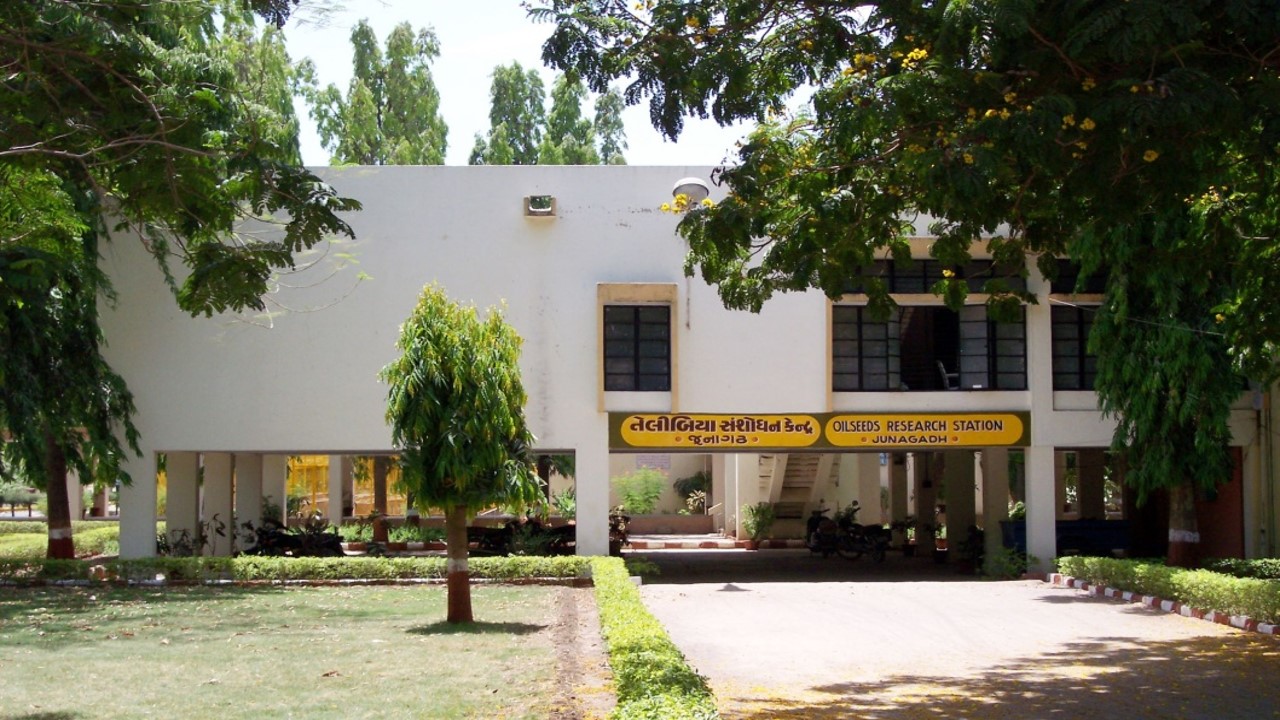
Year of Establishment : 1956
INTRODUCTION :
Gujarat plays a prominent role in oilseed production in the country with a share of 11.0% and 15.0 % in area and production, respectively towards oilseed crops of the country. Among the oilseeds, groundnut is the most important crop produced in Gujarat. The state is the largest producer of the groundnut in the country with a share of 32 % in area and 37 % in the production of groundnut in India. Out of the total area under oilseeds in Gujarat groundnut predominates and covers 63.4 % area and contributes 64.3% of the production of the oilseed crops.
HISTORY OF THE STATION :
The Main Oilseeds Research Station was established at Junagadh during the year 1956 in the state with the objectives to breed and develop high yielding, disease and pest resistant and better quality varieties of different oilseed crops like groundnut, castor, sesame, sunflower, soybean and mustard. Currently, the centre is actively engaged in groundnut research works in the main areas like,
1. Plant Breeding& Genetics - Crop improvement
2. Agronomy- Crop production
3. Plant Protection : (a) Agril. Entomology, (b) Plant Pathology
4. Plant Physiology
In addition to these, the station is also working as a testing center for Mustard, Sunflower and Sesame crops. The center also contributes the groundnut varieties and castor varieties / hybrids for National level research programme and it is one of the centre for the All India Coordinated Research Projects on Groundnut, National Seed Project, RKVY Seed Project and aflatoxin project.
Establishment of the Centre: 1956
The research work on oilseed crops started initially since 1956 and further integrated and strengthened at the Main Oilseeds Research Station at Junagadh with wide network of regional research station at Amreli, Jamnagar and Umrala (Saurashtra region), Talod, Vijapur and Manund (North Gujarat) and testing centers at Derol (Middle Gujarat ), Bhachhau (Kutch region), and Navsari ( South Gujarat ).
Establishment of AICRP Centre: 1968
Research schemes at that time consisted of the Integrated Oilseeds Research Scheme financed by State Government. The All India Co-ordinated Research Project on Oilseeds financed by the ICAR, New Delhi was established during the year 1968 for groundnut at Junagadh, castor at Vijapur and sesame breeding at Umrala.
Groundnut was introduced in India somewhere during 19th century and spread throughout country within a short period of five to six decades. Since then, this center has released 13 spanish bunch, 04 semi-spreading and 11 spreading type high yielding varieties of groundnut for Gujarat and other parts of the country, which has resulted in the increased in production and productivity of groundnut.
MANDATES OF RESEARCH :
1. To develop early maturing groundnut varieties with high yield potential, better quality and high oil content.
2. To develop disease, pest, drought and aflatoxin resistant groundnut varieties with good export potential.
3. Development early maturing runner varieties of groundnut.
4. To evolve production technologies for newly developed and improved varieties.
5. To provide breeder seed of groundnut varieties to the agencies of Gujarat and India.
6. To disseminate information generated through research to farmers through front line demonstrations.
7. To solve problems regarding groundnut production through radio, TV programmes, popular articles, hand outs, personal discussion, night discussion and by organizing farmers' day and week end training programmes etc.
OBJECTIVES :
1. Development of high yielding varieties tolerance to drought major diseases and pests
2. Incorporation of earliness especially in Virginia runner groundnut.
3. Development of HPS and confectionery groundnut varieties and development of appropriate production technology of groundnut
4. To evolve varieties of groundnut crop with high yield potential, better quality, with fresh seed dormancy (in Spanish bunch group) and drought, disease and pest resistance.
5. To develop agro technology and plant protection measures for newly released groundnut variety.
6. To produce breeder seeds of groundnut varieties as per state and national indents.
7. Preparation of database of aflatoxin in groundnut for Saurashtra region.
8. Farmers participatory research through on farm front line demostrations of groundnut
9. Scaling up of Rapid generation advancement (RGA) facilities to fast-track development of groundnut cultivars with industry- preferred traits
10. Identify the QTL(s) for industry-preferred traits in groundnut and develop cost-effective QTL(s) associated markers
RESEARCH ACTIVITIES :
I. Breeding
A. Groundnut
1. Crop Improvement
2. Testing of breeding materials
3. Fresh crosses to generate breeding materials.
4. Germplasm evaluation
5. Seed multiplication of promising lines
6. Seed production of groundnut varieties
7. Production of nucleus and breeder seed of groundnut as per the DAC indent received from Government of India and Govt. of Gujarat
8. Experimental works in State and AICRP trials of summer and kharif seasons
B. Sesamum: Varietal evaluation under state and national programme
C. Soyabean: Varietal evaluation under state and national programme
D. Mustard: Varietal evaluation under state and national programme
II. Agronomy
1. Water, nutrient and weed management in groundnut
2. Intercropping studies on groundnut
3. Survey of agronomic practices in the area of summer andkharif groundnut cultivation
4. Intercropping system of groundnut with castor, pearl millet, cotton and pigeon pea.
5. Agronomic practices for AVT (bunch, semi spreading, spreading) entries and new trials as per AICRP technical programme
III Entomology
1. Screening of groundnut entries / lines from PET, SSVT, LSVT, IVT and AVT for resistance to insect-pests in kharif and summer groundnut, Sesame and mustard
2. Monitoring of Spodoptera litura using pheromone trap, pest incidence in kharif groundnut.
3. Testing the bio-efficacy of certain insecticides and biorationals in Groundnut,Sesame and Mustard
IV. Plant Pathology
1. Survey and Monitoring of various diseases of oilseed crops to find out the intensity and disease situation in Saurashtra region of Gujarat.
2. Screening of Promising genotypes of oilseed crops against major diseases.
3. Integrated and ecofriendly management of major diseases of groundnut.
V. Plant Physiology
1. Physiological parameters studies on different groundnut entries in early maturity, greater partitioning of dry matter to pods during pod filling phase, presence of short term dormancy (7-15 days) in SB groundnut and drought tolerance.
INFORMATION OF UNIT HEAD :
| Name of Unit Head | Dr. N. D. Dholariya Research Scientist (Groundnut) (I/C) Ph.D. (Genetics & Plant Breeding) |
| Office | (0285) 2672080-90, PBX-325 (0285) 2670205 |
| Mobile | +91-7777930601 |
| rsoilseed@jau.in |
FACULTY INFORMATION :
RESEARCH STAFF :
| No. | Name | Designation & Email ID | Qualificat-ion | Specialized subject |
|---|---|---|---|---|
| 1 | Dr. S. P. Kachhadiya | Associate Research Scientist spkachhadiya@jau.in | Ph.D. | Agronomy |
| 2 | Dr. J. B. Bhut | Associate Research Scientist jignesh1315@jau.in | Ph.D. | Entomology |
| 3 | Dr. N. D. Dholariya | Associate Research Scientist drdholariya_oilseeds@jau.in | Ph.D. | Genetics & Plant Breeding |
| 4 | Dr. U. M. Vyas | Assistant Research Scientist baazraz@jau.in | Ph.D. | Plant pathology |
| 5 | Dr. G. K. Sapara | Assistant Research Scientist gksapara@jau.in | Ph.D. | Genetics & Plant Breeding |
| 6 | Dr. C. J. Rajani | Assistant Research Scientist rajanichirag@jau.in | Ph.D. | Genetics & Plant Breeding |
TECHNICAL STAFF :
| Sr. No. | Name | Designation | Qualification | Remarks |
|---|---|---|---|---|
| 1 | Shri. L. L. Limbadiya | Agriculture Officer | B.Sc (Agri.) | -- |
| 2 | Kumari H. R. Patel | Agriculture Officer | B.Sc (Agri.) | -- |
| 3 | Shri P. R. Patel | Agriculture Assistant | B.Sc (Agri.) | -- |
| 4 | Shri. R. D. Polara | Agriculture Assistant | M.Sc (Ento.) | -- |
| 5 | Shri D. P. Kamariya | Agriculture Assistant | B.Sc (Agri.) | -- |
COURSES TEACH BY FACULTY (U.G./P.G) :
| No. | Name of faculty | Discipline | Title of course | Credit |
|---|---|---|---|---|
| 1 | Dr. S. P. Kachhadiya | Agronomy | Principles and practices of water management | 2+1 |
| 2 | Dr. G. K. Sapara | Genetics & Plant Breeding | SST 508: Seed quality testing | 2+1 |
| 3 | Dr. N. D. Dholariya | Genetics & Plant Breeding | SST 506: Seed Legislation & Certification | 1+1 |
| 4 | Dr. C. J. Rajani | Genetics & Plant Breeding | GPB 5.3: Fundamentals of plant breeding | 2+1 |
RESEARCH PROJECTS & SCHEMES (ONGOING) :
| Sr. No | Name of the Scheme | Budget Head | Type of Scheme | Funding Agency | Year of Commencement |
|---|---|---|---|---|---|
| 1 | Project for Research in Oilseeds | 5008 | Non- Plan | State | 1972 |
| 2 | National Agricultural Research Project (NARP) | 7082/A | Non- Plan | State | 1987 |
| 3 | Strengthening Research in Oilseeds | 12008 | Plan | State | 1986 |
| 4 | All India Coordinated Research Project on Groundnut | 2008/1G | I.C.A.R. Plan | I.C.A.R. | 1968 |
| 5 | Aflatoxin and its management in groundnut at saurashtra region of Gujarat at oilseed | 12028 | Plan | State | 2014 |
| 6 | Rapid generation advancement based modern breeding approaches for industry preferred trails in groundnut | 12035 | Plan | State | 2023 |
| 7 | Production of groundnut breeder seed at farmers field and Oilseed, Junagadh | 18247-33 | -- | ICAR | 2014 |
| 8 | Private company project trial for testing of new Molecules against weeds, diseases & pest. | 1800849-60 (Total 12 project) | Other agency | Other agency | 2022 |
FARM DETAIL :
| (a) Name of the Agro-climatic Zone | South Saurashtra Agro-climatic zone-VI |
| (b) Rainfall | The annual rainfall of this region for the last 40 years is 813 mm |
| (c) Soil | Medium black calcareous type with average depth of 30 cm |
| (d) Temperature | Annual Average - Minimum : 20.00C Annual Average - Maximum : 34.30C |
| (e) Geographical Details | Climate : Subtropical Latitude: 21'5 N Longitude : 70'5 E MSL : 61 m Temperature varies : 8 0C to 44 0C |
| (f) Soil properties :- | |
| Type | Medium Black Calcareous type |
| pH | 7.9 |
| Organic Carbon | 0.33 % |
| Available N2 | 181 kg/ha |
| Available P2O5 | 38 kg/ha |
| Available K2O | 345 kg/ha |
LABORATORIES :
| No. | Name of instruments | Qty. | Utility |
|---|---|---|---|
| 1 | NMR (Nuclear magnetic resonance) | 01 | For measurement of oil content in different crop |
| 2 | BOD incubator | 01 | For incubation, isolation of different fungi and bacteria |
| 3 | Hot air oven | 01 | |
| 4 | Autoclave (vertical) | 01 | |
| 5 | Laminar air flow |
MAJOR ACHIEVMENTS :
A. GROUNDNUT
| Sr. | Name of variety | Year of release | Arearecommendedfor cultivation | Pod yield kg/ha | Oil % | Days to maturity | Remarks | |
|---|---|---|---|---|---|---|---|---|
| a. | Varieties released for kharif season | |||||||
| 1 | J-11 | 1964 | Gujarat | 1389 | 48.1 | 90-95 | Aflatoxin resistance | |
| 2 | GAUG-1 | 1973 | Gujarat | 1483 | 50.2 | 95-110 | High yielding | |
| 3 | GAUG-10 | 1973 | Gujarat | 1820 | 49.4 | 110-120 | High yielding | |
| 4 | GG-2 | 1986 | Gujarat | 1336 | 49.6 | 98 | Early maturing and high yielding | |
| 5 | GG-11 | 1987 | Gujarat | 1430 | 48.6 | 110-114 | Suitable for pre- monsoon sowing | |
| 6 | GG-12 | 1991 | Gujarat | 1437 | 49.6 | 112-115 | Early maturing and suitable for rainfed conditions | |
| 7 | GG-20 | 1991 | Entire Gujarat except North Gujarat | 1960 | 50.7 | 109 | High yield and oil content | |
| 8 | GG-3 | 1991 | Northern Maharashtra & Madhya Pradesh | 1283 | 51.0 | 100 | Early maturing | |
| 9 | GG-13 | 1994 | Gujarat | 1511 | 49.6 | 120 | Suitable for pre -monsoon sowing | |
| 10 | GG-5 | 1996 | Saurashtra | 1270 | 49.2 | 100 | Bold seeded | |
| 11 | GG-7 | 2000 | Gujarat &Rajasthan | 2194 | 48.5 | 99 | Bold seeded | |
| 12 | GG-14 | 2001 | Northern Rajasthan, U.P., Punjab & Haryana | 2159 | 52.0 | 123 | High oil content | |
| 13 | GG-15 | 2004 | Tamil Nadu, A.P., Karnataka, Kerala & Southern Maharashtra | 1737 | 47.0 | 116 | High yielding | |
| 14 | GG-21 | 2004 | Northern Rajasthan, U.P., Punjab & Haryana | 1843 | 53.0 | 123 | High yielding | |
| 15 | GG-8 | 2005 | Northern Maharashtra & Madhya Pradesh | 1716 | 46.0 | 106 | High yielding | |
| 16 | GG-16 | 2005 | Tamil Nadu, A.P., Karnataka, Kerala & Southern Maharashtra | 1992 | 46.0 | 119 | High yielding | |
| 17 | GJG- HPS-1 | 2008 | Saurashtra & South Gujarat | 2125 | 47.9 | 110-120 | Suitable for HPS and confectionary uses | |
| 18 | GJG-9 | 2010 | Gujarat | 1632 | 48.17 | 103 | High yielding | |
| 19 | GJG-17 | 2011 | Gujarat | 1798 | 48.51 | 121 | High yielding & Tolerant to stem rot | |
| 20 | GJG-22 | 2011 | Saurashtra & South Gujarat | 1770 | 51.62 | 118 | High yielding & Tolerant to collar rot | |
| 21 | GJG-18 | 2013 | Odisha, West Bengal, Jharkhand & Manipur | 1450 | 48.0 | 121 | High yield | |
| 22 | GJG-19 | 2014 | West Bengal, Jharkhand, Odisha & Manipur | 1876 | 47.0 | 122 | High yield and Tolerant to stem rot, rust & dry root rot | |
| 23 | GJG-32 | 2016 | Tamil Nadu, A.P., Telangana, Karnataka, & Southern Maharashtra | 2909 | 50.00 | 109 | High yield & oil content and tolerant to tikka & rust diseases | |
| 24 | GJG-32 | 2017 | Gujarat | 3392 | 53.9 | 112 | High yield & oil content and tolerant to tikka & rust diseases | |
| 25 | GG 23 | 2020 | Gujarat | 2800 | 49.7 | 121 | The reaction against tikka, rust, stem rot and collar rot and leaf defoliators damage | |
| 26 | GG 35 | 2020 | Gujarat | 3177 | 49.8 | 105 | Tolerant to stem rot, collar rot, rust and tikka as well asleaf defoliators damaged | |
| 27 | GG 38 | 2021 | Gujarat | 2966 | 48.91 | 106 | High yield and high oil yield and tolerant to tikka, rust, stem rot and collar rot diseases | |
| 28 | GG 39 | 2023 | Gujarat | 2619 | 51.52 | 113 | High Oleic acid (>79%) and high yield | |
| 29 | GG 40 | 2022 | Gujarat, Rajasthan, Tamil Nadu, Andra Pradesh and Telangana | 3321 | 51.00 | 113 | High yield, high oil yield and oleic acid (>80%) and tolerant to tikka, rust, stem rot and collar rot diseases | |
| b. | Varieties released for summer season | |||||||
| 30 | GG-2 | 1984 | Gujarat | 1947 | 49.0 | 120 | High yielding | |
| 31 | GG-4 | 1993 | Gujarat | 2007 | 50.8 | 119 | High yielding & early maturing | |
| 32 | GG-6 | 1999 | Gujarat | 2782 | 50.28 | 119 | High yielding | |
| 33 | GJG-31 | 2010 | Gujarat | 3483 | 49.24 | 117 | High yielding | |
| 34 | GJG-33 | 2017 | Andhra Pradesh, Telangana and Tamil Nadu | 2909 | 50.00 | 109 | High yielding & early maturing | |
| 35 | GG 36 | 2020 | Zone I (Punjab and U. P.) | 4165 | 50.00 | 108 | High yielding and Large seeded | |
કેન્દ્ર દ્વારા બહાર પાડવામાં આવેલ ચોમાસું મગફળીની નવી જાતો
PRODUCTION OF GROUNDNUT BREEDER SEED (YEAR: 2017-18 TO 2023-2024 IN QTL.) :
| Varieties | 2017-18 | 2018-19 | 2019-20 | 2020-21 | 2021-22 | 2022-23 | 2023-24 |
|---|---|---|---|---|---|---|---|
| GG-2 | 64.80 | 64.70 | 43.20 | 15.90 | 48.30 | 24.00 | 33.30 |
| GG-4 | 0.50 | 1.20 | -- | -- | -- | -- | -- |
| GG-5 | 28.15 | 60.30 | 66.60 | 28.20 | 33.50 | 20.00 | 22.80 |
| GG-6 | 0.80 | 4.80 | -- | -- | -- | -- | -- |
| GG-7 | 37.43 | 22.20 | 28.50 | 5.70 | 28.50 | 30.00 | 35.40 |
| GG-8 | 17.40 | - | -- | 0.96 | 3.60 | -- | 0.50 |
| GG-20 | 1887.00 | 1523.05 | 1415.40 | 765.20 | 1030.30 | 816.80 | 690.20 |
| GAUG10 | 39.00 | 94.50 | 120.10 | 48.00 | 75.90 | 90.00 | 160.30 |
| GG-11 | 107.70 | 108.30 | 81.30 | 39.60 | 153.00 | 90.00 | 63.60 |
| GG-13 | -- | 4.75 | 0.13 | -- | -- | -- | -- |
| GG-16 | 6.00 | -- | -- | 2.84 | 3.60 | -- | 0.50 |
| GG-21 | 41.40 | 10.20 | 12.30 | 11.96 | 16.20 | 0.60 | 6.90 |
| GJGHPS1 | 16.50 | 14.20 | 6.00 | 3.60 | 25.90 | -- | 0.50 |
| GJG HPS2 | -- | -- | 2.45 | 8.25 | 65.05 | 25.00 | 6.60 |
| GJG-9 | 134.57 | 100.70 | 165.90 | 177.90 | 365.65 | 150.00 | 210.30 |
| GJG-31 | 21.30 | 39.40 | 248.40 | 67.80 | 152.40 | 12.00 | 75.20 |
| GJG 32 | -- | 11.25 | 342.45 | 1023.30 | 4425.70 | 3548.70 | 1060.10 |
| GJG 33 | -- | -- | -- | 3.80 | 41.40 | -- | 22.50 |
| GG 35 | -- | -- | -- | -- | 9.80 | 20.10 | 295.00 |
| GG 36 | -- | -- | -- | -- | -- | -- | 0.10 |
| GG 37 | -- | -- | -- | -- | 31.00 | -- | 115.30 |
| GG 38 | -- | -- | -- | -- | -- | -- | 23.70 |
| GG 39 | -- | -- | -- | -- | -- | -- | 10.20 |
| GG 40 | -- | -- | -- | -- | -- | -- | 11.40 |
| GJG-17 | 109.75 | 136.50 | 125.40 | 95.10 | 284.10 | 60.00 | 51.60 |
| GJG-22 | 200.60 | 515.49 | 1154.40 | 1223.73 | 2239.27 | 735.80 | 655.10 |
| GG 23 | -- | -- | -- | -- | 5.80 | -- | 155.10 |
| GJG-18 | 10.18 | 0.75 | 74.10 | -- | 12.30 | -- | 11.70 |
| GJG-19 | 15.86 | 4.75 | -- | 1.42 | 5.00 | 0.30 | 12.30 |
| GJG 41 | -- | -- | -- | -- | 16.20 | 2.70 | 6.10 |
| Total | 2738.94 | 2717.04 | 3886.63 | 3523.96 | 9072.47 | 5626 | 3696.30 |
RECOMMENDATION :
AGRONOMY :
Groundnut
- The farmers of South Saurashtra Agro-climatic Zone growing kharif semi-spreading groundnut varieties having seed size of 42-45 and 50-52 g/100 seed are advised to sow at spacing of 45 cm x 10 cm with seed rate of 110 and 125 kg/ha, respectively for obtaining higher yield and net returns.
- The farmers of South Saurashtra Agro-climatic Zone growing groundnut during kharif season are advised to apply 75% recommended dose of chemical fertilizers(9.37-18.75-37.5 kg NPK/ha) with seed treatment of NPK liquid bio-fertilizer (250 ml/ha) + Zn solubilising bacteria (125 ml/ha) for obtaining higher pod yield and net return.
- The farmers of South Saurashtra Agro-climatic Zone growing semi-spreading groundnut during kharif are advised to sow at a spacing of 45cm x 10cm(seed rate 130 to 135 kg/ha) and apply either100% RDF(12.5-25-50 NPK kg/ha) + Bio-fertilizer (Rhizobium @ 10ml/1 kg seed, PSB& KMB soil application @ 2.0 litre/ha) or 50% RDF (6.25-12.5-25 NPK kg/ha) + 50% FYM (1250 kg/ha) + Bio-fertilizer (Rhizobium @ 10ml/1 kg seed, PSB & KMB soil application @ 2.0 litre/ha) for obtaining higher pod yield and net return.
- The farmers of South Saurashtra Agro-climatic Zone growing kharif bunch, semi-spreading and spreading groundnut under organic farming are advised to apply 50% RDN through FYM (1250 kg/ha) + 50% RDN through Vermicompost (312.50 kg/ha) for higher pod yield and net return.
- The farmers of South Saurashtra Agro-climatic Zone growing groundnut during summer season are recommended to apply potash @ 40 kg/ha through fertigation in 6 equal splits at 8 days interval (1st split at 20 DAS) along with recommended dose of N and P (25-50 kg N-P2O5 /ha) as basal for obtaining higher yield and net return.
- The farmers of South Saurashtra Agro-climatic Zone growing groundnut during summer season are recommended to apply 75% RDF (18.75-37.5-37.5 kg N-P2O5-K2O /ha) with seed treatment of NPK liquid biofertilizer (2 ml + 3 ml water/kg seed) and Zn solubilizing bacteria (1 ml + 4 ml water/kg seed) or 50% RDF (12.5-25-25 kg N-P2O5-K2O /ha) with seed treatment of bio-grow biofertilizer (1 ml + 4 ml water/kg seed) for obtaining higher yield and net return.
- The farmers of South Saurashtra Agro-climatic Zone growing groundnut during summer season are recommended to apply 75% RDF (18.75-37.5-37.5 kg N-P2O5-K2O /ha) as basal and spray 1.5% water soluble fertilizer (19-19-19% N- P-K) at 45, 60 and 75 DAS for obtaining higher yield and net return.
- The farmers of South Saurashtra region adopting intercropping system in semi-spreading groundnut during kharif season are recommend to grow groundnut + sesame (2:1) intercropping during kharif season and onion during rabi season
- The farmers of Gujarat state growing groundnut during kharif season are recommended to grow Spanish bunch high oleic groundnut variety Gujarat Groundnut 39 (GG 39: Sorath Uttam). This variety has recorded mean pod yield of 2619 kg/ha, which was 34.43, 11.74 and 2.24 per cent higher than the check varieties, GJG 9 (1949 kg/ha), TG 37A (2248 kg/ha) and GJG 32 (2489 kg/ha), respectively. This variety has also recorded higher kernel yield, oil yield and oleic acid (>79 %) than the check varieties. Stem rot disease was lower in GG 39, while tikka, rust and collar rot diseases were comparable to the check varieties. The infestation due to leaf defoliators was lower than the check varieties.
- The farmers of South Saurashtra Agro-climatic Zone growing pre-monsoon groundnut (last week of May) are recommended to apply foliar spray of 0.5 % FeSO4 heptahydrate (50 g/10 L water) with 0.05 % citric acid at 25 DAS and 1 % FeSO4 heptahydrate (100 g/10 L water) with 0.1 % citric acid at 35 and 45 DAS or foliar spray of 0.5 % FeSO4 heptahydrate (50 g/10 L water) with 1 % cow urine at 25 DAS and 1 % FeSO4 heptahydrate (100 g/10 L water) with 2 % cow urine at 35 and 45 DAS or foliar spray of 1.0 % micronutrient mixture grade IV at 45 and 60 DAS in addition to recommended dose of NPK fertilizers (12.5-25-50 N-P2O5-K2O kg/ha) to obtain higher yield, net return and reduction in yellowness.
- The farmers of South Saurashtra Agro-climatic Zone growing bunch groundnut (GJG 32) during kharif season are recommended to sow at spacing of 30 cm x 10 cm and apply 100 % RDF (12.5-25-50 kg N-P2O5-K2O/ha) + Bio fertilizer [Rhizobium (Rhizobium leguminosarum and Rhizobium meliloti 1 x 10⁷ cfu/ml)] @ 15 ml/kg seed; PSM (Bacillus subtilis 1 x 10⁸ CFU/ml) & KMB (Frateuria aurantia 1 x 10⁸ CFU/ml) soil application each @ 3 L/ha) as a basal for obtaining higher yield and net return.
- The farmers of Saurashtra region growing summer groundnut in medium black calcareous soil are recommended to apply three sprays of 0.2 % (20 ml/10 L water) nano boron OR 0.2 % (20 g/10 L water) boric acid at 30, 45 and 60 DAS in addition to recommended dose of fertilizer (25-50-50 N-P2O5-K2O kg/ha) to obtain higher yield and net return.
- The farmers of South Saurashtra Agro-climatic Zone growing kharif groundnut - rabi wheat sequence cropping are recommended to apply Fe 10 kg/ha, Zn 5 kg/ha and S 20 kg/ha in form of ferrous sulphate, zinc sulphate and cosavet (Fertis), respectively once in two years as basal, in both groundnut and wheat, for obtaining higher groundnut equivalent yield and net return.
- The farmers of South Saurashtra Agro-climatic Zone growing summer groundnut are recommended to apply 40 kg/ha of P2O5 + PSB (Bacillus subtilis-1 x 10⁸ CFU/g) culture @ 15 ml/kg seed in addition to recommended dose of nitrogen and potash (25-50 kg N-K2O/ha) for securing higher yield and net income.
- The farmers of South Saurashtra Agro-climatic Zone growing kharif groundnut are recommended to apply RDF 75 % (9.37:18.75:37.50 N: P2O5:K2O kg/ha) + 1.5% (150 g/10 liter water) WSF (19-19-19-N:P:K) at 45 and 60 DAS + 1.0 % (100 g/10 liter water) Muti-micro Mixture Grade –IV (Zn-6.0%, Fe-4.0%, Cu0.5%, Mn-1.0% and B-0.5%) at 50 and 65 DAS as a foliar spray for obtaining higher yield and net return.
Mustard
- The farmers of North Gujarat agro climatic zone IV growing mustard are recommended to apply 75 kg N/ha, of which 50% as basal and remaining 50% at 35-40 days after sowing, in addition to 50 kg P2O5/ha and 40 kg S/ha as basal for obtaining higher yield and net return. Application of potash is not found beneficial.
ENTOMOLOGY
- The farmers of South Saurashtra Agro-climatic Zone growing groundnut in Kharif season are advised to apply two sprays of chlorpyriphos 20 EC 0.05% (25 ml/10 l of water) or quinalphos 25 EC 0.05% (20 ml/10 l of water) at 15 days interval starting from pest infestation for effective and economical management of defoliators viz; Helicoverpa and Spodoptera.
- The farmers who are interested in organic groundnut production are advised to apply two sprays of pongemia oil (30 ml/10 l of water) or ponneem (30 ml/10 l of water) at 15 days interval starting from pest infestation for effective and economical management of defoliators viz; Helicoverpa and Spodoptera. To prepare ponneem, mix 45% of neem oil, 45% of pongemia oil (karanj oil) and 10% of soap solution (wetting agent).
- The farmers of South Saurashtra Agro-climatic Zone growing summer groundnut are advised to apply two sprays of imidacloprid 17.8 SL 0.005% (2.8 ml/10 l of water) at 10 days interval starting from pest infestation for effective and economical management of thrips. Pre-harvest interval (PHI) of 40 days should be kept.
- The farmers of South Saurashtra Agro-climatic Zone growing groundnut in Kharif season are recommended to detop the crop 5 cm in length from the top at 30 days after sowing for effective and economical management of defoliators viz; Helicoverpa & Spodoptera.
- The farmers of South Saurashtra Agro-climatic Zone growing groundnut in kharif season are advised to apply seed treatment with imidacloprid 600 FS @ 4 ml OR chlorpyriphos 20 EC @ 25 ml per kg of seeds for effective and economical management of white grub.
- The farmers of South Saurashtra Agro-climatic Zone are advised that the storage of fumigated groundnut pods in high density polythene (HDPE) bags or polythene layered gunny bags was more effective and economic in management of bruchid pest.
Mustard
- The farmers of South Saurashtra Agro-climatic Zone growing sesame in Kharif season are advised to apply two sprays of chlorpyriphos 20 EC 250 g a.i./ha (25 ml/10 lit. water) or quinalphos 25 EC 0.05% 250 g a.i./ha (20 ml/10 lit. water) at 7 days interval starting from pest infestation for effective and economical management of mustard leaf webber.
- Farmers of Gujarat growing mustard are recommended two sprays of thiamethoxam 25 WG 0.01% (4 g/10 L water), first spray when aphid crosses the ETL (1.5 aphid index/plant) and the second spray at 15 days after the first spray for the effective management of pest. A minimum pre-harvest interval (PHI) of 21 days should be kept.
PLANT PATHOLOGY
Groundnut
- Farmers interested in organic cultivation of groundnut are advised to apply Trichoderma harzianum 1 % WP (2 x 10⁶ cfu/g) as a seed treatment 10 g/kg seed along with its furrow application 4.0 kg/ha enriched in 300 kg FYM at the time of sowing for management of collar rot and stem rot diseases. Whereas, for leaf spot spray neem seed kernel extract 5 % (500 g/10 l of water) at 30, 45 and 60 DASOR to spray cow urine 10 % (1000 ml/10 l of water) at 20, 40, 60 and 80 days after sowing.
- The farmers of South Saurashtra Agroclimatic Zone (VII) growing kharif groundnut are advised to apply Trichoderma harzianum 1 % WP (2x 10⁶ cfu/g) as furrow application 4 kg/ha in 250 kg of castor cake at the time of sowing and soil drenching 4 kg/ha in soil at 30 days after sowing for effective and economical management of stem rot disease and obtaining higher pod yield. The application of 87 Trichoderma harzianum also resulted in growth promoting ability by increasing leaf dry weight, leaf area, plant height, number of branches, pods per plant and root length in groundnut.
- The farmers of South Saurashtra Agro climatic Zone (VII) growing kharif groundnut are advised seed treatment with mancozeb (75 % WP) 3g/kg of seed + furrow application of Trichoderma harzianum 1 % WP (2 x 10⁶ cfu/g) 2.5 kg in 250 kg of castor cake/ha at the time of sowing for effective and economical management of aflarot and obtaining higher pod yield. It is also effective for management of stem rot and collar rot.
Farmers interested in nonchemical cultivation of groundnut are advised seed treatment with Trichoderma harzianum 1 % WP (2x 10⁶ cfu/g) 10g/kg of seed + furrow application of Trichoderma harzianum 2.5 kg enriched before one week in 250 kg of FYM/ha at the time of sowing for effective and economical management of aflarot and obtaining higher pod yield. It is also effective for management of stem rot and collar rot. - The farmers of South Saurashtra Agro-climatic Zone growing kharif groundnut are advised to apply seed treatment of mancozeb 75 % WP @ 3 g/kg seeds follow by two sprays of hexaconazole 5 % SC, 0.005 % (10 ml/10 l of water) at 40 and 65 DAS for effective and economical management of early and late leaf spots (ELS & LLS) diseases of groundnut.
- Farmers who are interested in organic cultivation of groundnut are advised to apply Bijamrut as a seed treatment @ 10 ml/kg seed along with foliar spray of cow urine 10% (1 l /10 l of water) at 30 and 60 DAS for effective and economical management of tikka disease and to obtain higher pod and haulm yield.
- Farmers of Gujarat growing Kharif groundnut are recommended to apply seed treatment with carboxin 37.5 + thiram 37.5 WS @ 3 g/kg seed or carbendazim 25 + mancozeb 50 WS @ 3 g/kg seed or penflufen 13.28 + trifloxystrobin 13.28 FS @ 3 ml/kg seed as ready-mix fungicide for effective management of aflarot, collar rot and stem rot in groundnut.
AWARDS/MEDALS RECEIVED :
| No | Name of Award | Given by which Organization | Year |
|---|---|---|---|
| 1 | Best Oral Presentation (Plant pathology discipline) | Department of Plant Pathology, Anand Agricultural University, Anand. | 2017 |
| 2 | Prof. J. P. Trivedi Award for Best research | Gujarat Association For Agricultural Sciences (GAAS) | 2022 |
| 3 | Best Performing Groundnut Breeder Seed Producing Centre | ICAR-IIGR, Junagadh | 2024 |
PUBLICATIONS :
| No. | Detail | No. of publication |
|---|---|---|
| 1 | Research paper published | |
| a. International journal | 50 | |
| b. National journal | 100 | |
| 2 | Popular article | 105 |
| 3 | Booklet published | 06 |
| 4 | Bulletins | 05 |
| 5 | Paper published in seminar/symposium/conference | 45 |
LIST OF PUBLICATION :
| 1 | Naganna, R., Jethva, D. M., Bhut, J. B., Wadaskar, P. S. and Kachot, A. K. (2020) Present status of new invasive pest fall armyworm, Spodoptera frugiperda in India: A review Journal of Entomology and Zoology Studies 8 (2): 150-156. |
| 2 | Bharadiya, A. M., Savaliya, S. G., Patel, P. V., Bhut, J. B., Dhingani, J. C., Dholariya, N. D. and Gohil, P. J. (2019). Farmer First Programme: An effective communication approach for dissemination of sustainable groundnut production technology, Guj. J. Ext. Edu.; Special Issue on National Seminar: 1-4. |
| 3 | Patelia, V. R., Parmar, G. M., Kelaiya, D. S. and Vikani, R. M. (2019). Ecologically sustainable Management of shoot fly and stem borer in pearl millet, Journal of entomology and zoology studies, 7(5): 597-599 |
| 4 | Vaghasiya, P. M. and Dobariya, K. L. (2019). Nutrient management in Grounenut (Arachis hypogia L.) in Bt cotton intercropping system, Legume Research, 2(3): 4108-12 |
| 5 | Modh Zeal A., Jivani L. L., Kachhadia V. H., Valu, M. G. and Vadavia A. T. (2019). Heterosis for fruit yield and its components in Brinjal (Solanum melongena L.), The pharma innovation journals, 8(9): 50-53. |
| 6 | Vaghasiya, P. M. and Dobariya, K. L. (2019). Nutrient management in Grounenut (Arachis hypogia L.) in Bt cotton intercropping system, Legume Research, 2(3): 4108-12 |
| 7 | Umaretiya, V. R, Hirani N. V. and Marviya G. V.(2019). Molecular characterization of garlic (Allium sativum L.) genotypes differs in total soluble solid content. Journal of Pharmacognosy and Phytochemistry, 8(4):1165-1169. |
| 8 | Ukani, P. K., Mandavia, M. K., Bhalara R. L. and Marvia G.V. (2019). Biochemical analysis of Pearl millet (Pennisetum glaucum L.) Under Heat Stress Condition During Flowering Stage. International Journal of Chemical Studies, 7(2):1864-1868. |
| 9 | Umaretiya V. R., Hirani, N. V. and Marviya, G. V. (2019). Biochemical characterization of garlic (Allium sativum L.) genotypes differs in total soluble solid content. International Journal of Chemical Studies, 7(4):1629-1632 |
| 10 | G. K. Sapara*, R. B. Madariya and C. J. Rajani (2023). GG-40 A High Yielding and High Oleic Spanish Bunch Groundnut Variety, Frontiers in Crop Improvement, Vol 11: 422-424 (Special Issue-I). |
| 11 | Chaudhari, M. S., Akabari, V. R., Bhut, J. B., Dholariya, N. D. and Tribhuwan Singh (2025). Influence of plant growth regulators on yield attributes and induction of dormancy in bunch groundnut., Agriculture Association of Textile Chemical Reviews Journal, pp.599-604 |
EXTENSION ACTIVITIES :
FLD (Frontline Demonstrations):
The government of India, while realizing the import dependency of the edible oils, established the technology mission on Oilseeds (TMO) in 1986 which adopted four pronged strategy for reaping production, processing and storage technologies for attaining self reliance in oilseeds. The series of farmer oriented policies through TMO made an impact on the vegetable oil production of the country to shift from a stagnation stage to swift growth stage. The Adhoc Project on “Frontline demonstrations in oilseed Crops” sponsored by Department of Agriculture and Cooperation, Government of India was launched from Kharif, 1990-91. The above scheme amply provided opportunities to the researchers of the All India Coordinated Research Project on Oilseeds (AICORPO) actively in generation of location specific technologies for (1) demonstrating to farmers what they were advocating, (2) test their effect and viability, (3) obtain feed from the clients and (4) fine-tune the technologies to improve their acceptability and suitability to real farm situation.
| No. | Year | FLD | Total assigned | Total conduc-ted | |||
|---|---|---|---|---|---|---|---|
| Summer | Kharif | ||||||
| Assigned | Conducted | Assigned | Conducted | ||||
| 1 | 2017-18 | 20 | 19 | 25 | 23 | 45 | 42 |
| 2 | 2018-19 | 10 | 10 | 50 | 50 | 60 | 60 |
| 3 | 2019-20 | 10 | 10 | 50 | 52 | 60 | 62 |
| 4 | 2020-21 | 20 | 20 | 46 | 52 | 66 | 72 |
| 5 | 2021-22 | 20 | 15 | 50 | 54 | 70 | 96 |
| 6 | 2022-23 | 20 | 19 | 0 | 0 | 20 | 19 |
| 7 | 2023-24 | 20 | 20 | 100 | 100 | 120 | 120 |
LAB TO LAND ACTIVITIES :
| No. | Extension activities | 2017-2018 | 2018-2019 | 2019-2020 | 2020-21 | 2021-22 | 2022-23 | 2023-24 |
|---|---|---|---|---|---|---|---|---|
| 1 | No. of training programmes organized | 1 | 2 | 1 | 0 | 1 | 0 | 2 |
| No. of participants | 105 | 150 | 104 | 0 | 35 | 0 | 100 | |
| 3 | Field days | 5 | 3 | 4 | 1 | 1 | 2 | 2 |
| No. of participants | 348 | 289 | 250 | 25 | 30 | 65 | 70 | |
| 4 | Kishan Mela | 3 | 4 | 3 | 2 | 3 | 3 | 3 |
| 6 | Dissemination of technology through text messages and voice by mobile phones etc | 95 | 214 | 225 | 250 | 360 | 400 | 380 |
| 7 | Krishi Mahoshtav | 0 | 1 | 0 | 1 | 2 | 1 | 1 |
| 8 | TV/Radio talk | 8 | 9 | 10 | 2 | 1 | 2 | 2 |