
Dry Farming Research Station, Vallabhipur
Dry Farming Research Station
Junagadh Agricultural University
Vallabhipur
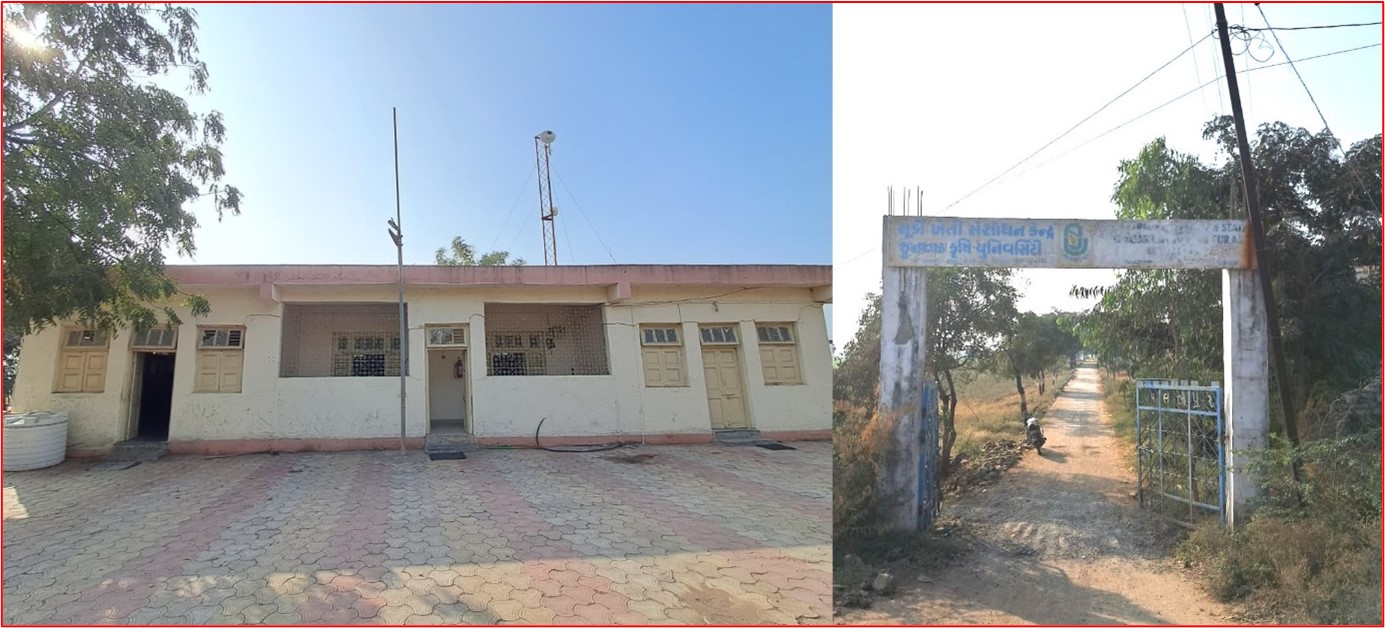
Year of Establishment : 1958
Introduction :
The DFRS, Vallabhipur was established by the Government of Bombay, Agril. & Forest Department Notification No. 606/1957/(5)F dated 26th May 1958 worth of Rs. 24,414/- for 24.94 hectares land started from 30th June, 1959. In 1972, when Gujarat Agricultural University came into existence, the activities of this station were then merged in it and in Junagadh Agricultural University with its inception from May 2004. The station is located in Bhal & Coastal Area Sub-zone-VIII (Tract of Bhavnagar district) of the Zone-13, Gujarat plains hills. The centre geographically situated on Latitude 21.530°N and Longitude 71.540°E, and has Altitude about 20 meter.
(1) The scheme for Strengthening of Existing Dry Farming Research Station and starting new Farming Research Station in Saurashtra was sanctioned by Director of Agriculture vide letter No. RES-F(2)Agril/3182 dated 21 st April, 1966 is under operation at this station, which was the implementation of the Govt. of Gujarat Resolution No. SCS/1063/28200-T,dated 19 th December, 1964.
(2) “Agricultural Demonstration Activities in SSP Command Area Ph-II” was initiated at Vallabhipur with the financial support of Sardar Sarovar Project Command Area (Phase-II) in October 2010. (Sanction order Number JAU/DR/Tech-2/19641-45/10 dated 6/10/2010 of Director of Research, Junagadh).
(3) The plan scheme “Strengthening of Dry Farming Research at Vallabhipur” was sanctioned by the Agriculture and Cooperation Department, Govt. of Gujarat Resolution No.જકવ-૧૨૨૦૧૧-૩૨૫૧-ક.તારીખ ૧૩ ડીસેમ્બર, ૨૦૧૨.
Mandate :
1. To screen and evale the varieties of high yielding potential, better grain quality and tolerance to different biotic and biotic stress.
2. To develop location specific production technology.
3. To act as testing center for multi-location trails of dry farming technology.
4. Dissemination of agricultural technology to the farmers.
5. Seed production Programme of high yielding varieties and its distribution to the farmers.
Objectives :
1. To conduct the various experiment of dry land and non-irrigated crops to screen the good material for this region.
2. To produce the HYVs and improved seeds and provide extension services to the farmers.
3. To distribute the improved seeds of dry land crops to the farmers of this region.
INFORMATION OF HEAD OF DEPARTMENT :
| Name | Dr. K.N. Vadaria |
| Designation | Assistant Research Scientist (Agronomy) |
| Email (O) | dfrsvlb@jau.in |
FACULTY INFORMATION :
| Sr. | Name | Designation | Qualification | Discipline | Remarks |
|---|---|---|---|---|---|
| 1 | Dr. K. N. Vadaria, | Assistant Research Scientist | Ph. D.(Agri.) | Agronomy | On pool |
STAFF INFORMATION :
| Sr. | Name | Designation | Remarks |
|---|---|---|---|
| 1 | Shri D.S. Rojasara | Agril. Assistant | - |
| 2 | Shri V.V. Makvana | Junior Clerk | - |
| 3 | Shri T.N. Bhut | Senior Research Fellow | Contract base |
| 4 | Shri H.M. Limbola | Agri. Assistant | Contract base |
| 5 | Shri V.B. Rathod | Agri. Assistant | Contract base |
Agro –climatic information of centre :
| Name of the Agro-climatic Zone | : | Bhal and Coastal Agro-climatic Zone ?VIII, AES 1 (b) and 3. |
| Rainfall | : | The annual rainfall of this region for last 25 years ranged from 827 mm to 113 mm with an average precipitation of 522 mm. |
| Soil | : | The soil of the station farm is medium black with clayey texture and sodic in nature. The PH of the ranges from 7.7 to 9.0. the soil is deficient in nitrogen and phosphorus but rich in potash content. |
| Temperature | : | The climatic condition of the area is harsh and arid. The South-West monsoon mostly around 20 th June and withdraws around first of October. The July and August are the months of moderate to heavy rains. The winter may be mild frostless but the summer vary hot having the temperature ranges about 40 oC to 45 oC in May and June. |
| Geographical Details: | ||
| Climate | : | subtropical arid |
| Latitude | : | 21.530°N |
| Longitude | : | 21.530°N |
| Altitude | : | 20 Mt. ASL |
| Temperature varies | : | 8 to 45° C |
| Average rainfall | : | 522 mm |
| Type of soil: | ||
| Texture | : | Clayey |
| pH | : | 8.2 |
| Organic Carbon | : | 0.56 % |
| Avail P 2 O 5 | : | 46 kg/ha. |
| Avail K 2 O | : | 547 kg/ha |
| EC | : | 0.22 ds/m |
| Water holding capacity | : | 50 % |
| Spore Space | : | 42 % |
| Field Capacity | : | 29.7 % |
| Permanent Wilting Point | : | 12 % |
Thrust Areas :
Research should be carried out in following field :
1. To workout the nutrient requirements of rainfed crops on cropping system basis.
2. To assess the economic viability of spices crops in Bhal region for introducing
3. To explore the potentiality of organic farming.
4. When Sardar Sarovar (narmada) canal irrigation water becomes available to this region, research on limited irrigation will required for all the crops of this region as water stagnation in the salty soil of this tract cause adverse effect on soil health and crop yield too.
5. To study the effect of deep ploughing along with mulch on “ insitu ’ moisture conservation.
6. To work out the package of practices for newly released variety suitable to the area specific.
7. To act as multi-location testing center for dry farming technologies and conduct the demonstration on farmers fields.
Schemes Operating :
| Sr. | Name of Scheme | Budget Head | Type of Scheme | Funding Agency |
|---|---|---|---|---|
| 1. | Dry Farming Research Scheme | 5042 | Non Plan | State Govt. |
| 2. | Agricultural Demonstration Activities in SSP Command Area Ph-II | 18005-05 | Other Agency | Sardar Sarovar Narmada Nigam Ltd. |
| 3. | Strengthening of Dry Farming Research at Vallabhipur | 12020 | Plan | State Govt. |
Infrastructure Facility and Major Equipments available :
1. 20.10 ha cultivated land
2. Tractor, Mini tractor and all important farm implements
3. Office building in farm
4. Two godown, One implement shed and Two fodder sheds in farm
Major Achievements of Research :
1) Contribution was given to release chickpea varieties Gujarat Gram – 1, Gujarat Gram - 2, Gujarat Gram - 4, Gujarat Junagadh Gram – 3, Gujarat Gram- 5 and Gujarat Junagadh Gram-6.
2) Following recommendation to farmers was made by centre:
1) The farmers of Bhal region growing gram under conserve soil moisture condition are recommended to apply 20-40-0-20 kg N-P2O5-K2O-S/ha for obtaining higher yield and net monetary returns.
2) The farmers of Bhal region growing Bt cotton under rainfed condition are recommended to apply pendimethalin (30% EC) 0.900 kg/ha (3 lit./ha) as pre-emergence fb HW and IC at 30 and 60 DAS OR HW and IC at 30, 60 and 90 DAS for effective weed management and achieving higher seed cotton yield and net realization.
3) The farmers of Bhal region growing Bt cotton under rainfed condition are recommended to apply 80-40-80-20 kg N-P2O5-K2O-S/ha for obtaining higher yield and net return. The nitrogen should be applied in three splits i.e. 25% as basal at the time of sowing, 50 and 25% as top dressing at 35-40 and 60-65 days after sowing, respectively by drilling at 10 cm soil depth.
4) The farmers of Bhal and Coastal Zone-VIII growing Bt. cotton under rainfed condition are recommended to sowing of cotton at 75 cm X 30 cm spacing for getting higher yield and net returns under rainfed farming condition.
5) The farmers of Bhal and Coastal Zone-VIII sowing Bt. cotton under rainfed condition are recommended to sow cotton with tied ridges and furrow at 3.0 m interval or Broad bed and furrow (120 cm x 60 cm) or ridge and furrow (30 cm x 60 cm) for getting higher yield and net returns under rainfed farming condition.
3) Frontline Demonstrations :
a) FLDs on High Density Planting System (H.D.P.S) in Bt Cotton.
| YEAR | Variety | No. of FLDs conducted | Seed cotton yield (kg/ha) | % increase over farmer practices | |
|---|---|---|---|---|---|
| Improved practices | Farmer practices | ||||
| 2020-21 | G.Cot.Hy-8 | 12 | 1163 | 1150 | 1.13 |
| 2021-22 | G.Cot.Hy-8 | 11 | 1267 | 1231 | 2.92 |
| 2022-23 | G.Cot.Hy-8 | 16 | 2323 | 2240 | 3.71 |
| 2023-24 | G.Cot.Hy-8 | 16 | 1560 | 1166 | 33.75 |
| 2024-25 | G.Cot.Hy-8 | 16 | 1683 | 1340 | 25.63 |
b) FLDs on Performance of Bt cotton variety G.Cot.Hy-8 or GTHH-49 BG-II.
| YEAR | Variety | No. of FLDs conducted | Seed cotton yield (kg/ha) | % increase over farmer practices | |
|---|---|---|---|---|---|
| Improved practices | Farmer practices | ||||
| 2020-21 | G.Cot.Hy-8 | 21 | 1874 | 1861 | 0.70 |
| 2021-22 | G.Cot.Hy-8 | 21 | 1447 | 1421 | 1.83 |
| 2022-23 | G.Cot.Hy-8 | 16 | 1655 | 1558 | 6.23 |
| 2023-24 | G.Cot.Hy-8 | 16 | 1519 | 1238 | 22.73 |
| 2024-25 | G.Cot.Hy-49 | 16 | 1639 | 1292 | 26.81 |
c) FLDs on Management of insect pests in cotton.
| YEAR | Variety | No. of FLDs conducted | Seed cotton yield (kg/ha) | % increase over farmer practices | |
|---|---|---|---|---|---|
| Improved practices | Farmer practices | ||||
| 2020-21 | G.Cot.Hy-8 | 21 | 2031 | 2014 | 0.84 |
| 2021-22 | G.Cot.Hy-8 | 11 | 1638 | 1611 | 1.68 |
| 2022-23 | G.Cot.Hy-8 | 12 | 1780 | 1701 | 4.64 |
| 2023-24 | G.Cot.Hy-8 | 11 | 1478 | 1207 | 22.48 |
| 2024-25 | G.Cot.Hy-8 | 11 | 1547 | 1227 | 26.01 |
d) FLD on irrigation management in cotton (G.Cot.Hy-10 BG-II) through drip using canal water.
| YEAR | Variety | No. of FLDs conducted | Seed cotton yield (kg/ha) | % increase over farmer practices | |
|---|---|---|---|---|---|
| Improved practices | Farmer practices | ||||
| 2020-21 | G.Cot.Hy-10 | 20 | 2374 | 2351 | 0.98 |
| 2021-22 | G.Cot.Hy-10 | 20 | 1550 | 1522 | 1.84 |
| 2022-23 | G.Cot.Hy-10 | 10 | 3130 | 3040 | 2.96 |
| 2023-24 | G.Cot.Hy-10 | 10 | 1512 | 1154 | 31.04 |
| 2024-25 | G.Cot.Hy-10 | 10 | 1531 | 1188 | 28.93 |
e) FLDs on improved agril practices in chickpea.
| YEAR | Variety | No. of FLDs conducted | Seed yield (kg/ha) | % increase over farmer practices | |
|---|---|---|---|---|---|
| Improved practices | Farmer practices | ||||
| 2020-21 | GJG-3 | 16 | 1311 | 1282 | 2.26 |
| 2021-22 | GJG-3 | 15 | 1943 | 1910 | 1.73 |
| 2022-23 | GJG-3 | 18 | 1341 | 1281 | 4.68 |
| 2023-24 | GJG-3 | 16 | 1251 | 960 | 30.37 |
| 2024-25 | GJG-3 | 16 | 1517 | 1216 | 25.44 |
f) FLDs on supplemental irrigation in chickpea (GJG-3) grown under conserved moisture.
| YEAR | Variety | No. of FLDs conducted | Seed yield (kg/ha) | % increase over farmer practices | |
|---|---|---|---|---|---|
| Improved practices | Farmer practices | ||||
| 2020-21 | GJG-3 | 15 | 1960 | 1929 | 1.61 |
| 2021-22 | GJG-3 | 14 | 1340 | 1310 | 2.29 |
| 2022-23 | GJG-3 | 17 | 1612 | 1544 | 4.40 |
| 2023-24 | GJG-3 | 14 | 1442 | 1156 | 24.74 |
| 2024-25 | GJG-3 | 15 | 1507 | 1184 | 27.29 |
g) FLDs on improved agril practices in wheat in (only two irrigation on critical stages).
| YEAR | Variety | No. of FLDs conducted | Seed Yield (kg/ha) | % increase over farmer practices | |
|---|---|---|---|---|---|
| Improved practices | Farmer practices | ||||
| 2020-21 | GW-496 | 20 | 3378 | 3414 | 1.07 |
| 2021-22 | GW-496 | 21 | 3451 | 3480 | 0.84 |
| 2022-23 | GW-496 | 25 | 3664 | 3801 | 3.74 |
| 2023-24 | GW-496 | 25 | 2943 | 2672 | 10.15 |
| 2024-25 | GW-496 | 30 | 2988 | 2642 | 13.11 |
Achievements :
The following seed production Programme of improved varieties were taken in last five years and distributed to the farmer.
Breeder & Truthful Seed Production :
| Year | Crop | Variety | Stage | Production (kg) |
|---|---|---|---|---|
| 2020-21 | Gram | GJG-3 | Truthful seed | 7500 |
| 2021-22 | Gram | GJG-3 | Truthful seed | 7600 |
| 2022-23 | Gram | GJG-3 | Truthful seed | 11100 |
| 2023-24 | Gram | GJG-3 | Truthful seed | 850 |
| 2024-25 | Gram | GJG-3 | Truthful seed | 10140 |
Contact :
Dr. K.N. Vadaria,
Assistant Research Scientist (Agronomy)
Dry Farming Research Station
Junagadh Agricultural University
Vallabhipur (District: Bhavnagar)
E-Mail : dfrsvlb@jau.in, knvadaria@jau.in