
Pulses Research Station, Junagadh
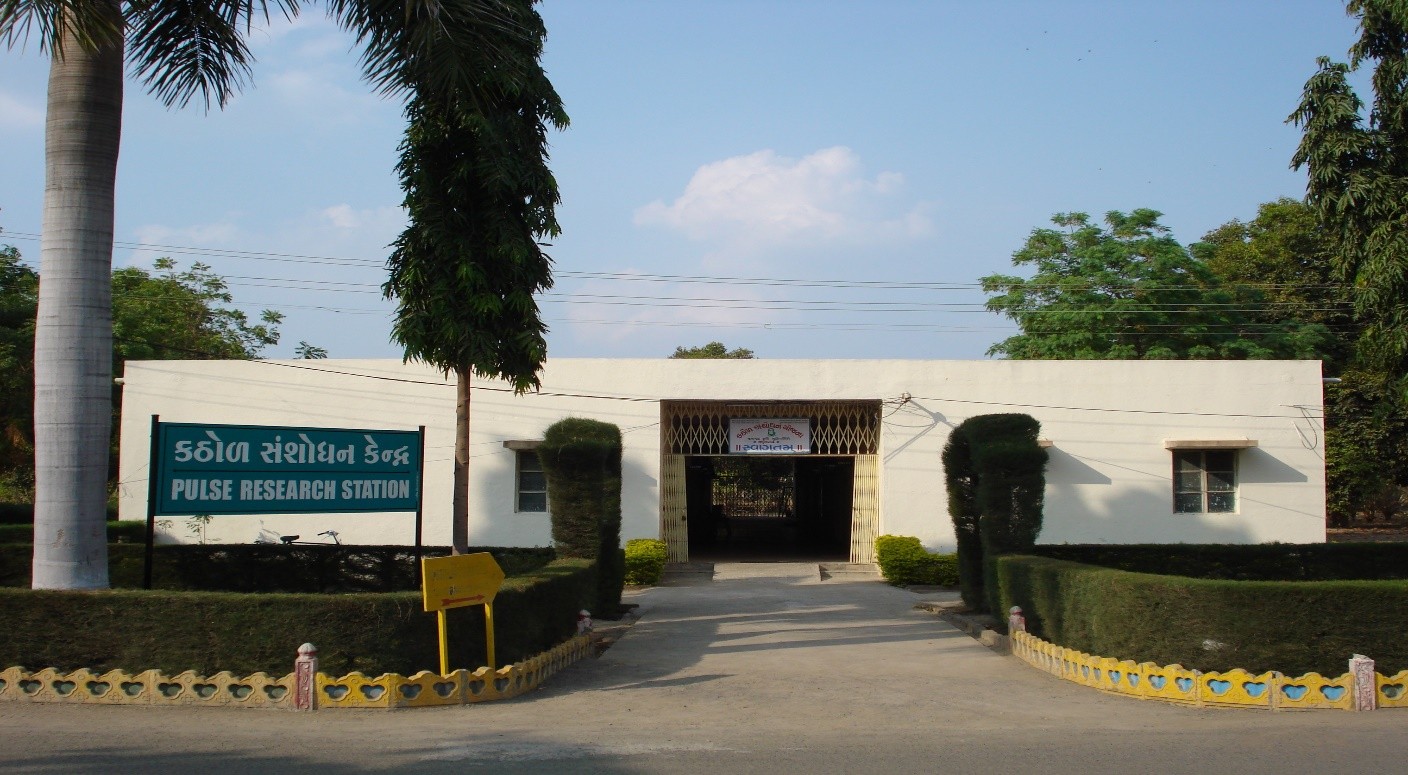
INTRODUCTION :
This station was established in the year 1965-66 as small research scheme. But expansion took place after the establishment of All India Coordinated Pulses Improvement at Junagadh during 1975-76. This station became mandatory centre for chickpea research at national level under AICRP on chickpea in 1993. It also recognized as sub centre of pigeonpea under AICRP on pigeonpea project in the year 2001. The center is engaged with applied research in crop improvement, agronomy, entomology and plant pathology disciplines with respect to chickpea, pigeonpea, mungbean and urdbean. Moreover, this center is also collaborating with ICAR, ICRISAT and other agencies for chickpea and pigeonpea improvement programme. Besides research activities, this center is engaged in the production of nucleus and breeder seed of chickpea and pigeonpea. Scientists also participate in P. G. research and guiding of P. G. students.
MANDATE :
1. Collection, evaluation and maintenance of germplasm of different pulse crops like chickpea, pigeonpea, mungbean and urdbean.
2. Development of varieties of above crops with high yield potential, better grain quality and tolerance to different biotic and abiotic stress.
3. Development of location specific production and protection technologies.
4. Dissemination of technology to the farmers.
5. Monitoring the diseases & insect pests. Screening of genotypes against diseases & key insects and integrated management of insect pests of pulses.
6. Seed production of improved varieties of pulses.
7. Conduct of Frontline Demonstration in chickpea and pigeonpea.
OBJECTIVES :
1. To Collect, evaluate and maintain the germplasm of mandate crops viz; chickpea, pigeonpea, mungbean and urdbean.
2. To enrich the germplasm for developing high yielding disease and insect pest resistant and better grain quality varieties.
3. To develop varieties of above crops having high yield potential better grain quality and resistant to biotic and abiotic stresses.
4. To evaluate newly developed genotypes under various environments to find out their suitability.
5. To develop location specific production technology in pulses.
6. To carry-out screening and testing of newly developed genotypes against various diseases and insects and workout effective as well as economical control measures.
7. To produce and distribute good quality seed of chickpea, pigeonpea, mungbean and urdbean varieties.
8. To disseminate production and protection technology to the farmers by using various extension tools.
INFORMATION OF UNIT HEAD :
| Name of Unit Head | Dr. R. M. Javia Research Scientist (Chickpea) |
| Office no. | (0285) 2677407 |
| E- mail | chickpea@jau.in |
FACULTY PROFILE :
| Sr. | Name | Designation | Qualification | Specialized Subject |
|---|---|---|---|---|
| 1. | Dr. R. M. Javia | Res. Scientist (Chickpea) | Ph.D. | Gen. & Pl. Breeding |
| 2. | Dr. L. K. Sharma | Res. Scientist | Ph.D. | Gen. & Pl. Breeding |
| 3. | Dr. S. V. Lathiya | Assoc. Res. Sci. | Ph.D. | Plant Pathology |
| 4. | Dr. N. P. Rathod | Asstt. Res. Sci. | Ph.D. | Agril. Entomology |
| 5. | Dr. A. R. Trambadiya | Asstt. Res. Sci. | Ph.D | Agronomy |
| 6. | Shri V. B. Paradva | Agril. Officer | M.Sc. (Agri.) | Agril. Extension |
| 7. | Shri. P. P. Chavda | Agril. Assistant | Agri. Diploma | - |
| 8. | Shri. J. G. Kanjariya | Agril. Assistant | Agri. Diploma | - |
| 9. | Shri. B. J. Dhakel | Agril. Assistant | B.Sc. (Agri.) | - |
| 10. | Shri. H. F. Bandhiya | Agril. Assistant | B. Teach (Food Tech) | - |
| 11. | Shri. N. N. Kavathiya | Agril. Assistant | B.Sc. (Agri.) | - |
| 12. | Shri. M. P. Dobariya | Agril. Assistant | B.Sc. (Agri.) | - |
| 13. | Shri. C. D. Javiya | Junior Clerk (on Pull) | B. Com. | - |
RESEARCH PROJECT AND SCHEMES ONGOING :
| Sr. | Name of Scheme | Budget Head | Type of Scheme | Funding Agency |
|---|---|---|---|---|
| 1. | StrengtheningResearch in Pulses | 12007 | Plan | State Govt. |
| 2. | Project for Research in Pulses | 5007 | Non-plan | State Govt. |
| 3. | A.I.C.R.P. on Rabi Pulses (Chickpea) | 2374 | AICRP | ICAR 75% State 25% |
| 4. | A.I.C.R.P. on Kharif Pulses (Pigeonpea) | 2374-5 | AICRP | ICAR 75% State 25% |
| 5. | The Front line demonstration on Chickpea | 2374-1 | AICRP | ICAR 100% |
| 6 | The Front line demonstration on Pigeonpea | 2374-6 | AICRP | ICAR 100% |
| 7. | Efficacy evaluation of imidacloprid 180 g/l+ penflufen 50 g/l fs on green gram crop as seed treatment | 18003-13 | Other agency | Bayer Crop Science Limited |
| 8. | Efficacy evaluation of imidacloprid 180 g/l + penflufen 50 g/l fs on chickpea crop as seed treatment | 18003-16 | Other agency | Bayer Crop Science Limited |
PROJECT COMPLETED :
| Sr. | Name of Scheme | Duration | Funding Agency | Budget Head | Project cost (Rs. in lakh) |
|---|---|---|---|---|---|
| 1. | Evaluation of Bio-efficacy and phytotoxicity of Solomon 300 OD against gram pod borer and sucking pest in chickpea | 2 Year (2007-08 to 2008-09) | Bayer crop science Ltd. | 18009-15 | 01.60 |
| 2. | Evaluation of Bio-efficacy and phytotoxicity of flubendiamide 480 SC against pod borer in chickpea | 2 Year (2008-09 to 2009-10) | Bayer crop science Ltd. | 18003-08 | 02.00 |
| 3. | Evaluation of Bio-efficacy and phytotoxicity of flubendiamide 90%+Deltamethrin 60%- 150 Sc against pod borer in chickpea | 2 Year (2011-12 to 2012-13) | Bayer crop science Ltd. | 18003-09 | 05.30 |
| 4. | Utilizing Chickpea Genome sequence for crop improvement | 3 Year (2014-15 to 2016-17) | DAC of Govt. of India via ICRISAT | 18003-10 | 38.58 |
| 5. | Evaluation of Bio-efficacy of Chlorpyrifos 50% + Cypermethrin 5% EC against pod borer and pod fly and other insect pest of pigeonpea | 2 Year (2018-19 to 2019-20) | Gharda Chemical Ltd. | 18003-11 | 07.25 |
| 6. | Evaluation of Bio-efficacy and phytotoxicity of Paclobutrazol 40% SC (Plant growth regulator) on plant growth and yield in chickpea and its effect on succeeding crop | 2 Year (2019-20 to 2020-21) | Excel Crop Care Ltd. | 18003-12 | 09.30 |
| 7. | To evaluate Crop safety of Tetraniliprole 200 g/L sc (Vayego) on chickpea crop applied through drone | 1 Year (2024) | Bayer Crop Science Ltd. | 18003-14 | 4.95 |
| 8. | Evaluation of Efficacy of Penflufen 154 g/L + Trifloxystrobin 154 g/L FS on greengram crop as seed treatment | 2 Year (2024-25 to 2025-26) | Bayer Crop Science Ltd. | 18003-13 | 8.60 |
INFRASTRUCTURE FACILITIES AND MAJOR EQUIPMENTS AVAILABLE :
1. Cultivated land – 14 ha
2. One well & one borewell for irrigation
3. Two tractor with all important farm implements
4. One pair of bullock
5. Office building in campus
6. Two Godown in Farm
7. One mini tractor with farm implements
ACHIEVEMENTS :
CHICKPEA :
Following 8 Desi and 2 Kabuli chickpea varieties have been developed, released and notified by this station for cultivation.
| Characters | Varieties | |||||
|---|---|---|---|---|---|---|
| Gujarat Gram 1 | Gujarat Gram 2 | Gujarat Gram 4 | Gujarat Junagadh Gram 3 | Gujarat Gram 5 | Gujarat Junagadh Gram 6 | |
| Year of Notification | 1999 | 1999 | 2000 | 2010 | 2017 | 2016 |
| Parents | GCP 2 X ICCV 2 | JG 1258 X BDN 9-3 | ICCL 84224 X Annigeri | ICCV 93001 X ICCV 10 | GJG 9707 X IPC 97-7 | GJG 0105 X FG 711 |
| Notified area | Central Zone & Gujarat | Bhal area of Gujarat | North East Plain Zone | Gujarat | Gujarat | Gujarat |
| Released for | Irrigated & Rainfed conditions | Rainfed | Irrigated and Rainfed | Rainfed | Irrigated | Rainfed |
| 100-seed weight (g) | 18.0 | 30.5 | 17.4 | 22.77 | 21.37 | 22.45 |
| Seed shape | Smooth and round | Smooth and round | Smooth and round | Owl's head | Angular | Angular |
| Seed colour | Reddish brown | Reddish brown | Brown | Yellow | Brown | Brown |
| Disease reaction | Tolerant to wilt | Tolerant to wilt | Tolerant to wilt | Moderately Resistant to wilt and stunt | Moderately Resistant to wilt and resistant to stunt | Resistant to wilt and stunt |
| Maturity days | 105-110 | 90-95 | 120-130 | 98 | 103 | 112 |
| Seed yield (kg/ha) | 2200 (Irrigated) 1750 (Rainfed) | 1300 (Rainfed) | 1900 to 2000 | 1700-1800 (Rainfed) | 2500 to 2700 (Irrigated) | 1800 to 2000 (Rainfed) |
| Characters | Varieties | |||||
|---|---|---|---|---|---|---|
| Gujarat Gram 7 (GG 7) | Gujarat Kabuli Gram 1 (GKG 1) | Gujarat Gram 8 (GG 8) | Gujarat Kabuli Gram 2 (GKG 2) | Gujarat Gram 9 (GG 9) | Gujarat Gram 10 (GG 10) | |
| Year of Notification | 2021 | 2021 | 2023 | 2023 | 2026 | - |
| Parents | ICCV 03112 X JG 130 | ICCV 14195- P3 X ICCV 92337 | PG 07104 X WR315 | VIHAR X ICCV 95333 | GG 2 X ICCV 05529 | ICCV 10 X ICCV 96836 |
| Notified area | Gujarat | Gujarat & NWPZ of India | Gujarat, NEPZ and SZ of India | Gujarat | Gujarat and ECZ of India | Gujarat |
| Released for | Rainfed | Rainfed and irrigated | Rainfed and irrigated | Irrigated | Irrigated | Irrigated |
| 100-seed weight (g) | 26.1 | 43.5 | 20.8 | 35.8 | 27.5 | 28.3 |
| Seed colour | Brown | Beige | Brown | Beige | Brown | Brown |
| Disease reaction | Resistant to stunt and moderately resistant to wilt | Resistant to stunt | Resistant to stunt and wilt | Resistant to stunt and wilt | Resistant to wilt and Moderately Resistant to Stunt | Resistant to wilt and Moderately Resistant to Stunt |
| Maturity days | 95 | 102 | 105 | 110 | 105 | 96 |
| Seed yield (kg/ha) | 1900-2200 | 2000-2200 (irrigated) 1300 (rainfed) | 2600-2800 (irrigated) | 2100-2300 (irrigated) | 2600-2900 (Irrigated) | 2500-2800 (Irrigated) |
| Remarks | For Mechanical harvesting | For Mechanical harvesting | ||||
Click here to see the Chickpea Photographs
PIGEONPEA :
Following pigeonpea varieties have been developed, released and notified for cultivation by the station.
| Characters | Variety | ||
|---|---|---|---|
| Gujarat Junagadh Pigeonpea 1 (GJP 1) | Gujarat Tur 111 (GT 111) | Gujarat Tur 112 (GT 112) | |
| Year of Notification | 2016 | 2024 | 2025 |
| Parents | LRG 41 X BDN 2 | GT-102 X BDN-2010 | ICPL 87119 X AGT 2 |
| Notified area | Gujarat state | Gujarat state | Gujarat state |
| Released for | Irrigated | Irrigated | Irrigated |
| 100-seed weight (g) | 11.7 | 12.88 | 11.10 |
| Seed shape | Oval | Oval | Oval |
| Seed colour | White | White | Red Brown |
| Disease reaction | Moderately Resistant to wilt & SMD | Resistant to wilt & SMD | moderately resistant against wilt and resistant against SMD |
| Maturity days | 177 | 177 | 176 |
| Seed yield (kg/ha) | 2000 to 2100 | 2100 to 2300 | 2200-2500 |
Click here to see the Pigeonpea Photographs
URDBEAN :
Following urdbean variety have been developed, released and notified
| Characters | Variety |
|---|---|
| Gujarat Urd -2 (Krishna) | |
| Year of Notification | 2020 |
| Parents | CoBG 593 x TPU 4 |
| Notified area | All Gujarat |
| Released for | Kharif |
| Growth habit | Semi erect |
| Plant habit | Determinate |
| Twining habit | Non-viny |
| Seed colour | Greenish brown |
| Seed shape | Drum |
| Seed size | Large |
| Pubescence on pod | Present |
| Mature pod length | Long |
| Days to maturity | Medium (82) |
| Seed yield (kg/ha) | 1300 to 1500 |
Click here to see the Urdean Photographs
MUNGBEAN :
Following mungbean variety have been developed, released and notified for cultivation
| Characters | Variety |
|---|---|
| Gujarat Mung -10 | |
| Year of Notification | 2023 |
| Parents | GM-4 X BPMR-145 |
| Notified area | All Gujarat |
| Released for | Kharif |
| Growth habit | Erect |
| Plant habit | Determinate |
| Twining habit | Non-viny |
| Seed colour | Greenish |
| Seed shape | Drum |
| Seed size | Large |
| Pubescence on pod | Absent |
| Mature pod length | Long |
| Days to maturity | Early (65-70) |
| Seed yield (kg/ha) | 1100-1300 |
Click here to see the Mungbean Photographs
OTHER ACHIEVEMENTS :
FLDS ON CHICKPEA :
| YEAR | Type of FLD | Variety | No. of FLDs conducted | Improved practices (q/ha) | Farmer practices (q/ha) | % increase over farmer practices |
|---|---|---|---|---|---|---|
| 2012-13 | Full package technology | GJG 3 | 10 | 16.88 | 13.88 | 21.62 |
| 2013-14 | 10 | 17.85 | 15.10 | 18.21 | ||
| 2014-15 | 10 | 14.50 | 12.51 | 15.90 | ||
| 2015-16 | 15 | 15.60 | 13.66 | 14.20 | ||
| 2016-17 | 10 | 15.43 | 13.78 | 11.97 | ||
| 2017-18 | GG 5 | 10 | 29.31 | 25.08 | 16.86 | |
| 2018-19 | GG 5 | 10 | 21.29 | 18.80 | 11.60 | |
| 2019-20 | GG 5 | 10 | 25.25 | 21.01 | 20.00 | |
| 2020-21 | GG 5 | 20 | 25.68 | 21.62 | 18.77 | |
| GJG 6 | ||||||
| 2021-22 | GG 5 | 20 | 23.69 | 19.91 | 18.99 | |
| GJG 6 | ||||||
| 2022-23 | GG 5 | 20 | 25.75 | 21.94 | 17 | |
| GJG 6 | ||||||
| 2023-24 | GG 7 | 4 | 22.60 | 18.70 | 21 | |
| GG 8 | 5 | 25.44 | 21.20 | 20 | ||
| GKG 1 | 1 | 24.00 | 19.00 | 26 | ||
| 2024-25 | GG 5 | 10 | 23.90 | 20.30 | 20 | |
| GJG 6 | 10 | 24.10 | 19.80 | 19 |
For the popularization of newly released chickpea variety among farmers along with improved package of practices, 10 FLDs were conducted in different villages of Saurashtra region in each year. Results clearly indicated the superiority of improved package of practices over farmers’ practices. Farmers got yield advantage ranging from 11.60 to 21.62 per cent. Another advantage of FLD was observed in the awareness of superiority of new variety GJG 3 and GG 5. Some low cost technology like seed treatment and 2% spray of urea as well as application of bio agents like Trichoderma also became familiar among farmers. FLD farmers sold seed of GJG 3 and GG 5 to neighbour farmers in the next year. This way FLDs are useful in spread of new variety.
(B) FLDS ON GROUNDNUT-PIGEONPEA RELAY CROPPING SYSTEM :
Impact of FLDs:
The rainfall in Saurashtra is erratic and scanty. The major groundnut crop is always under high risk. Farmers have adopted pigeonpea as a relay crop in groundnut because of the following reasons.
1. It does not reduce the area of groundnut as pigeonpea is being sown between two rows of groundnut in the month of August.
2. It does not decrease the yield of groundnut; hence the income from pigeonpea is treated as an additional income.
3. It covers the risk of major crop of groundnut in irregular monsoon and scarcity condition.
4. It provides valuable nutritive fodder for cattle, which is an essential requirement for the farmers of Saurashtra.
5. It can be grown with limited irrigation facilities in which any other winter crop cannot be grown.
Since last two decades more than 300 FLDs were conducted on groundnut-pigeonpea relay cropping system in six districts of Gujarat. The tested pigeonpea varieties were BDN 2, BSMR 853, BSMR 736 and GT 101. Pigeonpea varieties BDN 2 and GT 101 were highly popular among the farmers as these varieties require only 2-3 irrigations after end of the monsoon. FLD farmers harvested on an average 1299 kg/ha seed yield. Pigeonpea as a relay crop in groundnut was found highly remunerative without any adverse effect on sole groundnut yield. The market price of pigeonpea is highly attractive hence farmers adopting this system quickly. Pigeonpea variety GJP 1 has been demonstrated in FLDs during kharif 2017-18 to 2020-21. In kharif 2020-21 variety GJP 1 produced on an average 2541 kg/ha seed yield in varietal demonstrations which was 29.05% higher over farmers’ practices. Over all farmers got 17.00 to 29.05% increase in seed yield. The performance was appreciated by the farmers of FLDs. This variety is become popular among farmer.
| YEAR | Type of FLD | Variety | No. of FLDs conducted | Improved practices (q/ha) | Farmer practices (q/ha) | % increase over farmer practices |
|---|---|---|---|---|---|---|
| 2013-14 | Full package technology | GT 101 | 10 | 17.60 | 15.25 | 15.40 |
| 2014-15 | 10 | 13.90 | 11.85 | 17.29 | ||
| 2015-16 | 10 | 12.50 | 10.42 | 19.96 | ||
| 2016-17 | 10 | 15.12 | 13.33 | 13.43 | ||
| 2017-18 | GJP 1 | 10 | 17.93 | 14.22 | 26.09 | |
| 2018-19 | 10 | 17.94 | 14.72 | 18.30 | ||
| 2019-20 | 10 | 16.89 | 14.47 | 17.00 | ||
| 2020-21 | 10 | 25.41 | 19.69 | 29.05 | ||
| 2021-22 | 10 | 18.42 | 14.68 | 25.48 | ||
| 2022-23 | GJP 1 | 09 | 16.59 | 14.07 | 16.00 | |
| 2023-24 | GJP 1 | 15 | 17.68 | 14.72 | 20.00 | |
| 2024-25 | GJP 1 | 14 | 16.42 | 15.25 | 17.00 | |
| 2025-26 | GJT 111 | 15 | 19.49 | 16.00 | 22.00 | |
| Average | 17.38 | 14.51 | 19.77 | |||
RECOMMENDATIONS :
CROP PRODUCTION :
CHICKPEA :
Effect of biofertilizer along with molybdenum application on yield of chickpea :
The farmers of South Saurashtra Agro-climatic Zone growing irrigated chickpea are advised to treat seeds with Rhizobium culture @ 25 g/kg seed + phosphate solubilizing bacterial culture (Bacillus subtilis) 30 g/kg seed along with recommended dose of fertilizers (20:40 N: P2O5 kg/ha) for securing higher yield and net return. Application of molybdenum in chickpea was not found advantageous.
Evaluation of chickpea varieties under different dates of sowing under irrigated condition :
The farmers of South Saurashtra Agro-climatic Zone growing irrigated chickpea are advised to sow the crop during first fortnight of November (mean minimum temperature 19.9 °C and mean maximum temperature 34.7 °C) for securing higher yield and net return.
Effect of different irrigation scheduling and irrigation interval through drip on chickpea :
The farmers of South Saurashtra Agro-climatic Zone growing chickpea under drip irrigation system are recommended to irrigate the crop with drip system at 0.8 ETc at 5 days interval through drip after two flood irrigations for getting higher yield, net return and 27 % saving of irrigation water. The system details are as under :
| Lateral spacing: 90 cm | Operating time | |
| Dripper spacing: 45 cm | Month | Minutes |
| Dripper discharge rate: 4 LPH | December | 57 |
| Operating pressure: 1.2 kg/cm2 | January | 104 |
| Operating frequency: every 5th day irrigation | February | 65 |
Irrigation management through critical stages of chickpea :
The farmers of South Saurashtra Agro-climatic Zone interested to grow chickpea under water crisis condition are recommended to irrigate the chickpea crop at four critical stages like branching, flowering, pod initiation and grain filling apart from two common irrigations, first immediately after sowing and second at 6-7 days after sowing for getting higher yield and for saving 17 per cent of irrigation water.
Management of chickpea crop under organic farming (Recommendations for scientific community) :
It is for the information of scientific community that under South Saurashtra Agro-climatic Zone, application of FYM @ 4 t/ha + vermicompost 1.0 t/ha + either Trichoderma harzianum (2 x 10⁷ cfu/g) @ 2.5 kg /ha or Pseudomonas fluorescens (1 x 10⁸ cfu/g) 2.5 kg/ha + Rhizobium culture (1 x 10⁷ cfu/g) 5 ml/kg seed + PSB (1 x 10⁷ cfu/g) 5 ml/kg seed + two spray of Beauveria bassiana (2 x 10⁶ cfu/g) 40 g/10 L water at 50% flowering and 2nd spray at 15 days after 1st spray found the most economical in chickpea.
Effect of multi-micronutrient formulations on chickpea (2021) :
The farmers of South Saurashtra Agro-climatic Zone growing chickpea in medium black calcareous soil are recommended to apply micronutrients as per soil test value or multi micronutrients formulation Grade-V 40 kg/ha as basal in addition to recommended dose of fertilizers (20-40-0 N-P2O5-K2O kg/ha) to chickpea for obtaining higher yield and net return.
Biofortification of Zn and Fe in chickpea through agronomic intervention (2021) :
The farmers of South Saurashtra Agro-climatic Zone growing chickpea are recommended to apply ZnSO4 25 kg/ha as soil application along with recommended dose of fertilizer (20-40-0 N-P2O5-K2O kg/ha) for obtaining higher yield and net return along with Biofortification of Zn in seed and straw.
PIGEON PEA :
Effect of multi-micronutrient formulations on pigeonpea :
The farmers of South Saurashtra Agro-climatic Zone -VII growing pigeonpea are advised to apply micronutrients on soil test basis or multi-micronutrient mixture Grade-V @ 40 kg/ha besides recommended dose of fertilizer (25:50:0 N: P2O5:K2O kg/ha) to get higher yield and net returns.
Effect of different organic, inorganic and bio-fertilizers on groundnut-pigeonpea relay cropping system :
The farmers of South Saurashtra Agro-climatic Zone following groundnut pigeonpea (2:1) relay cropping system are advised to apply recommended dose of fertilizers to both the crops to obtain higher yield and net returns or 50% RDF + FYM 5 t /ha along with seed treatment of Rhizobium and phosphate solubilizing bacteria (each 25-30 g/kg seed) to groundnut only to reduce the dose of chemical fertilizers.
Optimizing spacing for medium duration pigeonpea varieties under pigeonpea + urdbean inter cropping system :
The farmers of South Saurashtra Agro-climatic Zone adopting pigeonpea + urdbean (without fertilizer) inter cropping system are advised to sow pigeonpea at 120 cm x 30 cm spacing and two rows of urdbean in between two rows of pigeonpea for getting higher yield and net return.
Nutrient and pest management in pigeonpea :
The farmers of South Saurashtra Agro-climatic Zone, growing kharif pigeonpea are recommended to apply recommended dose of fertilizer (25-50-50 N-P2O5-K2O kg/ha) and spray of indoxacarb 14.5 SC 0.010% (7 ml/10 lit of water) at 50% flowering and spray of chlorantraniliprole 18.5 SC 0.006% (3 ml/10 lit of water) 15 days after 1st spray.
Alternatively, apply recommended dose of fertilizer (25-50-50 N-P2O5-K2O kg/ha) and spray of multi micronutrient formulation Grade IV 20 ml/10 lit and spray of indoxacarb 14.5 SC 0.010% (7 ml/10 lit of water) at 50% flowering and spray of chlorantraniliprole 18.5 SC 0.006% (3 ml/10 lit of water) 15 days after 1st spray for obtaining higher seed yield and net realization.
Productivity of different medium duration pigeonpea varieties under different row spacing :
The farmers of South Saurashtra Agro-climatic Zone, growing kharif pigeon pea are recommended to grow medium duration pigeonpea variety GJP 1 with spacing of 120 cm x 25 cm to obtain higher seed yield and net realization.
URDBEAN :
Weed management in kharif Urdbean :
The farmers of South Saurashtra Agro-climatic Zone growing kharif urdbean are recommended to apply quizalofop-ethyl 40 g/ha (5 EC 16 ml/10 lit water) at 20 days after sowing (DAS) and hand weeding at 40 DAS for obtaining higher yield and net realization as well as effective weed management.
PLANT PROTECTION :
CHICKPEA :
Efficacy of new molecules against Helicoverpa armigera in chickpea :
For effective and economic control of pod borer (Helicoverpa armigera) in chickpea crop, farmers of South Saurashtra Agro-climatic Zone are advised to apply two sprays of chlorantraniliprole 20 SC 0.003% (1.5 ml/ 10lit. water) or emamectin benzoate 5 SG 0.001% (2 g/ 10 lit. water). First spray should be applied at 50% flowering and second at 15 days after first spray. The PHI for these insecticides is 27 days.
Evaluation of botanicals, bio-pesticides and insecticides against gram pod borer :
The farmers of South Saurashtra Agro-Climatic Zone growing chickpea are advised to apply alternate spray of HaNPV2 x 109 POBs/ml (5 ml/10 lit. water) and chlorantraniliprole 18.5 SC 0.004% (2 ml/10 lit. water) for effective and economic control of pod borer (Helicoverpa armigera) in chickpea crop. First spray to be started at 50% flowering and second at 15 days after first spray. The PHI for chlorantraniliprole 18.5 SC is 11 days.
Management of chickpea crop under organic farming :
It is for the information of scientific community that under South Saurashtra Agro-climatic Zone, application of FYM @ 4 t/ha + vermin-compost 1.0 t/ha + either Trichoderma harzianum (2 x 10⁷ cfu/g) @ 2.5 kg /ha or Pseudomonas fluorescens (1 x 10⁸ cfu/g) 2.5 kg/ha + Rhizobium culture (1 x 10⁷ cfu/g) 5 ml/kg seed + PSB (1 x 10⁷ cfu/g) 5 ml/kg seed + two spray of Beauveria bassiana (2 x 10⁶ cfu/g) 40 g/10 L water at 50% flowering and 2nd spray at 15 days after 1st spray found the most economical in chickpea.
Phenology based application of selective insecticide/ biopesticides combinations for Spodoptera exigua and Helicoverpa armigera in chickpea. (2021) :
Spraying of profenophos 50 EC 0.13% (26 ml/10 l water) followed by emamectin benzoate 5 SG 0.002% (4 g/10 l water) 15 days after first spray was found effective against Spodoptera exigua and pod borer (Helicoverpa armigera) infesting chickpea.
Management of chickpea crop under organic farming (Scientific) :
It is for the information of scientific community that under South Saurashtra Agro-climatic Zone, application of FYM @ 4 t/ha + vermicompost 1.0 t/ha + either Trichoderma harzianum (2 x 10⁷cfu/g) @ 2.5 kg /ha or Pseudomonas fluorescens (1 x 10⁸ cfu/g) 2.5 kg/ha + Rhizobium culture (1 x 10⁷ cfu/g) 5 ml/kg seed + PSB (1 x 10⁷ cfu/g) 5 ml/kg seed + two spray of Beauveria bassiana (2 x 10⁶ cfu/g) 40 g/10 L water at 50 % flowering and 2nd spray at 15 days after 1st spray found the most economical in chickpea.
Wilt management of chickpea under field condition
The farmers of saurashtra agro climatic zone growing chickpea are recommended to apply seed treatment of Prochloraz 5.7 % + Tebuconazole 1.4 % w/w ES @ 0.3 ml/Kg seeds at the time of sowing for the effective control of chickpea wilt.
PIGEONPEA :
Testing bio-efficacy of certain insecticides against pod borer complex on pigeonpea :
The farmers of South Saurashtra Agro-climatic Zone are advised to apply two sprays of spinosad 45 SC 0.009% (2 ml/ 10 lit. water) or thiodicarb 75 WP 0.075% (10 g/ 10 lit. water) or flubendiamide 48 SC 0.0096% (2 ml/ 10 lit. water) or chlorantraniliprole 20 SC 0.003% (1.5 ml/ 10 lit. water) starting from 50 per cent flowering and second spray at 15 days after first spray for the control of pod borer complex in pigeonpea. The PHI for these insecticides is 30 days.
Nutrient and pest management in pigeonpea :
The farmers of South Saurashtra Agro-climatic Zone, growing kharif pigeonpea are recommended to apply recommended dose of fertilizer (25-50-50 N-P2O5-K2O kg/ha) and spray of indoxacarb 14.5 SC 0.010% (7 ml/10 L of water) at 50% flowering and spray of chlorantraniliprole 18.5 SC 0.006% (3 ml/10 L of water) 15 days after 1st spray. Alternatively, apply recommended dose of fertilizer (25-50-50 N-P2O5-K2O kg/ha) and spray of multi micronutrient formulation Grade IV 20 ml/10 liter and spray of indoxacarb 14.5 SC 0.010% (7 ml/10 L of water) at 50% flowering and spray of chlorantraniliprole 18.5 SC 0.006% (3 ml/10 L of water) 15 days after 1st spray for obtaining higher seed yield and net realization.
URDBEAN :
Testing bio-efficacy of certain insecticides against pod borer complex on urdbean :
Farmers of South Saurashtra Agro-climatic zone are advised to apply two sprays of chlorantraniliprole 18.5 SC, 0.006 % (3 ml/ 10 lit. water) or flubendiamide 48 SC, 0.0096 % (2 ml/ 10 lit. water), first spray at 50 per cent flowering and second at 15 days interval for the control of pod borer complex in urdbean.
The PHI for chlorantraniliprole 18.5 SC is 20 days, whereas 11 days for flubendiamide 48 SC.
Integrated management of foliar fungal diseases of urdbean
Farmers of the South Saurashtra agro climatic zone grwoing urdbean are recommended to treat urdbean seed with carbendazim 25 + mancozeb 50 WS @ 2 g/kg of seed at the time of sowing and to apply foliar spray of metiram 55 + pyraclostrobin 5 WG or tebuconazole 50 + trifloxystrobin 25 WG at the initiation of disease and second spray at 15 days after the first spray for effective management of anthracnose and powdery mildew, leading to higher seed yield and net returns.
MUNGBEAN
Integrated management of foliar fungal diseases of mungbean
Farmers of the South Saurashtra agro climatic zone growing mungbean are recommended to treat mungbean seed with carbendazim 25 + mancozeb 50 WS @ 2 g/kg of seed at the time of sowing and to apply foliar spray of metiram 55 + pyraclostrobin 5 WG (30 g/10 lit or tebuconazole 50 + trifloxystrobin 25 WG (7 g/10 lit) at the initiation of disease and second spray at 15 days after the first spray for effective management of anthracnose and powdery mildew, leading to higher seed yield and net returns.
PUBLICATIONS: RESEARCH PAPERS, EXTENSION LITERATURE, BOOKS, ETC. :
| Sr. | Name of Scientist | Designation | Research Papers | Popular Articles | Other |
|---|---|---|---|---|---|
| 1 | Dr. R. M. Javia | Res. Scientist. (Pl. Breeding) | 35 | 10 | 26 |
| 2 | Dr. L. K. Sharma | Res. Scientist. (Pl. Breeding) | 59 | 2 | 2 |
| 3 | Pro. M. K. Chudasama | Asstt. Res. Sci. (Pl. Patho.) | 8 | 4 | - |
| 4 | Dr. N. P. Rathod | Asstt. Res. Sci. (Agril. Ento.) | 6 | 4 | 2 |
| 5 | Pro. A.R. Trambadiya | Asstt. Res. Sci. (Agronomy) | 5 | 20 | 3 |
LIST OF PUBLICATION OF YEAR (2020-21 to 2025-26) :
CLICK HERE TO SEE THE LIST OF PUBLICATION OF YEAR (2020-21 to 2025-26) :
SEEDS PRODUCTION :
Quantity of Breeder seed of chickpea produced during 2004-05 to 2025-26
| Breeder seed produced (q) | ||||||||||||
|---|---|---|---|---|---|---|---|---|---|---|---|---|
| Year | GG-4 | GG-1 | GG-2 | GJG 3 | GG 5 | GJG 6 | GG-7 | GKG-1 | GG-8 | GKG-2 | GG-9 | Total |
| 2004-05 | - | 155.70 | 26.25 | - | - | - | - | - | - | - | - | 363.9 |
| 2005-06 | - | 33.00 | 30.00 | - | - | - | - | - | - | - | - | 126.00 |
| 2006-07 | 1.80 | 32.50 | 31.02 | - | - | - | - | - | - | - | - | 128.84 |
| 2007-08 | 19.50 | 135.01 | 52.02 | - | - | - | - | - | - | - | - | 393.56 |
| 2008-09 | 6.25 | 71.00 | 47.82 | - | - | - | - | - | - | - | - | 243.89 |
| 2009-10 | 12.70 | 41.00 | 23.49 | - | - | - | - | - | - | - | - | 141.68 |
| 2010-11 | 24.75 | 44.77 | 40.50 | 09.75 | - | - | - | - | - | - | - | 214.79 |
| 2011-12 | 43.50 | 57.00 | 40.65 | 53.55 | - | - | - | - | - | - | - | 345.90 |
| 2012-13 | 21.75 | 61.50 | 29.45 | 35.85 | - | - | - | - | - | - | - | 275.35 |
| 2013-14 | 22.00 | 31.50 | 78.25 | 98.15 | - | - | - | - | - | - | - | 437.80 |
| 2014-15 | 6.50 | 29.00 | 71.25 | 81.25 | - | - | - | - | - | - | - | 369.50 |
| 2015-16 | 32.77 | 30.50 | 20.53 | 58.75 | 8.00 | - | - | - | - | - | - | 268.33 |
| 2016-17 | 45.25 | 19.90 | 26.50 | 82.00 | 45.50 | - | - | - | - | - | - | 393.05 |
| 2017-18 | 8.00 | 16.50 | 28.32 | 84.10 | 76.25 | - | - | - | - | - | - | 418.34 |
| 2018-19 | 9.75 | 12.00 | 13.75 | 107.73 | 225.50 | 5.53 | - | - | - | - | - | 738.77 |
| 2019-20 | 5.95 | 13.25 | 07.75 | 151.25 | 80.51 | 63.00 | - | - | - | - | - | 637.47 |
| 2020-21 | 18.00 | 08.00 | 06.50 | 152.00 | 78.50 | 38.00 | - | - | - | - | - | 584.00 |
| 2021-22 | - | 09.00 | 15.50 | 16.50 | 174.25 | 61.50 | - | - | - | - | - | 553.50 |
| 2022-23 | - | 17.75 | 07.50 | 149.50 | 98.75 | 101.00 | 12.25 | 08.00 | - | - | - | 789.50 |
| 2023-24 | - | 1.00 | 9.00 | 171.75 | 242.00 | 65.50 | 34.45 | 38.75 | 16.00 | - | - | 578.45 |
| 2024-25 | - | - | 12.50 | 259.00 | 158.25 | 51.50 | 167.00 | 85.00 | 247.25 | 9.25 | - | 989.75 |
| 2025-26 | - | - | 8.00 | 178.75 | 130.75 | 6.50 | 105.75 | 55.75 | 260.25 | 50.75 | 3.75 | 800.25 |
Quantity of Breeder seed of pigeonpea produced during kharif 2016-17 to 2025-26 :
| Breeder seed produced (q) | |||
|---|---|---|---|
| Year | GJP 1 | GT 111 | GT 112 |
| 2016-17 | 31.50 | - | - |
| 2017-18 | 30.50 | - | - |
| 2018-19 | 17.50 | - | - |
| 2019-20 | 09.30 | - | - |
| 2020-21 | 03.20 | - | - |
| 2021-22 | 10.50 | - | - |
| 2022-23 | 05.10 | - | - |
| 2023-24 | 6.80 | - | - |
| 2024-25 | 8.00 | - | - |
| 2025-26 | 8.00 | 60.90 | 12.00 |
Quantity of Breeder seed of Urd and Mung produced during kharif 2021-22 to 2025-26 :
| Urd (q) | Mung (q) | |
|---|---|---|
| Year | GU 2 | GM-10 |
| 2021-22 | 11.70 | - |
| 2022-23 | 04.00 | - |
| 2023-24 | 09.50 | 6.00 |
| 2024-25 | 12.00 | 6.00 |
| 2025-26 | 18.70 | 17.00 |
EXTENSION ACTIVITIES :
| Sr. No. | Extension activities | 2017-18 | 2018-19 | 2019-20 | 2020-21 | 2021-22 | 2022-23 | 2023-24 | 2024-25 | 2025-26 |
|---|---|---|---|---|---|---|---|---|---|---|
| 1 | TV/ Radio talk | 4 | 4 | 5 | 7 | 4 | 6 | 6 | 7 | 9 |
| 2 | No. of FLDs conducted | 20 | 20 | 20 | 30 | 30 | 25 | 20 | 20 | 15 |
| 3 | No. of Training programme organized | - | - | - | - | - | - | - | - | - |
| 4. | Krishi Mahotsav | 1 | 1 | 0 | 0 | 0 | 1 | 1 | 1 | 1 |
| 5. | MGMG | 5 | 5 | 5 | 5 | 5 | 5 | 5 | 5 | 5 |
| 6. | Krishi Mela/ Krishi Pradarshan | 1 | 1 | 0 | 2 | 1 | 1 | 2 | 1 | 1 |